
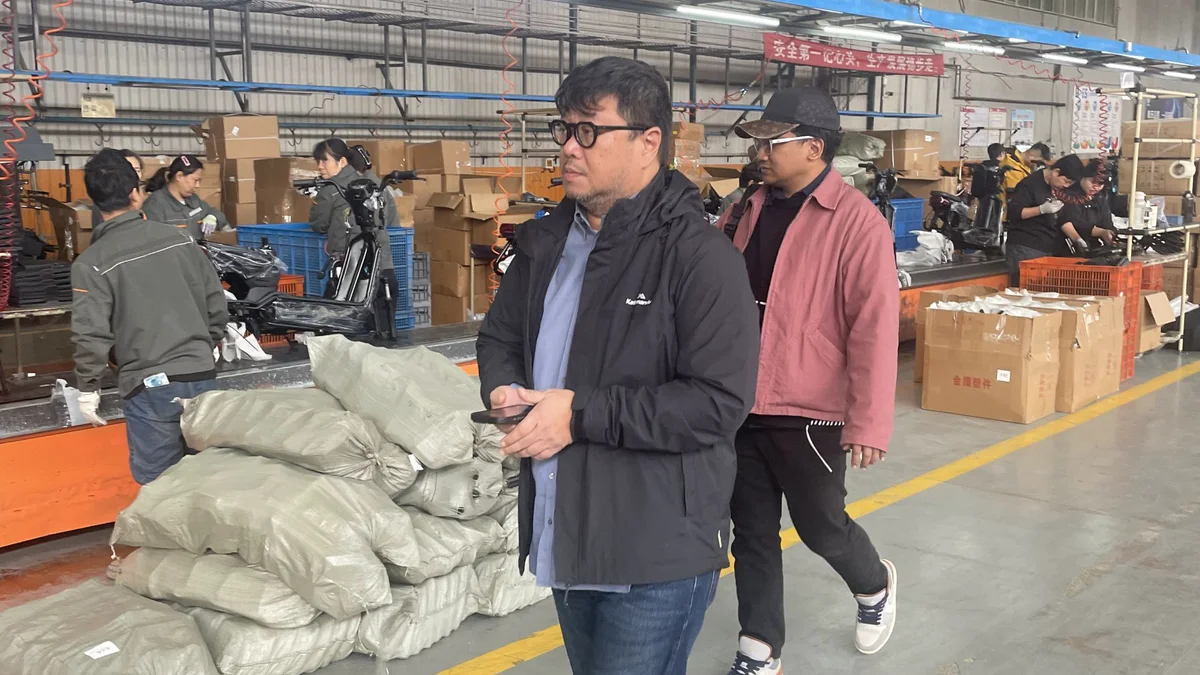
On October 27, 2026, BODO published a walk-through of an overseas partner delegation's on-site factory audit at its China electric-vehicle production base. While that visiting team examined two-wheelers in the showroom, the factory audit itself centered on export fundamentals that apply directly across BODO's manufacturing floor: sequential component fitting along the assembly line, parts staged in labeled bags and cartons beside each station, racks of coated frames, corrugated sea-freight carton inventory for complete units as well as SKD and CKD kits, and an OEM/ODM customization meeting covering colors, branding, and configurations. Alongside BODO's October 2026 electric-tricycle catalog updates—which list cargo and industrial models such as the SL003 and SL005 in complete-unit or CKD/SKD export form—BODO also highlighted live-video factory tours as an option for overseas buyers who cannot travel before ordering a sample.
For a fast-moving importer preparing a first sample or small trial batch, a factory audit does not need to turn into a multi-week consulting project. Whether conducted in person or over a live, unedited video call, a focused 60-minute floor check can catch the assembly, finish, and packing gaps that most commonly delay first-time electric-tricycle shipments.
Four physical areas to verify on the factory floor
Paper quotations and brochure images show what a supplier intends to sell; a live walk-through shows how orders are actually staged and controlled. Ask the factory team to walk continuously—without cutting the camera feed on a video audit—through four zones:
- Active assembly stations and parts staging: Look at how fasteners, harnesses, controllers, and sub-assemblies are organized beside each station. Neat kitting in labeled bags and trays reduces missed bolts, swapped connectors, and inconsistent build quality between sample and production units.
- Coated-frame storage and corrosion prep: Inspect stacked frames before final assembly. Check weld seams around cargo-bed mounts and steering heads, look for uniform paint or powder coating inside corners, and verify frames are racked off wet floors with protective spacing so coatings are not chipped before packing.
- Export carton and crating inventory: Review the actual sea-freight cartons, steel skids, and foam or wrap materials stored in the packing bay. Ask to see how heavy rear axles, battery trays, handlebars, and painted body panels are isolated inside an SKD or CKD crate to prevent transit abrasion.
- End-of-line inspection area: Confirm where finished units—or pre-packed sample builds—undergo brake, throttle, lighting, steering-alignment, and charging checks before entering the packing bay, and request a blank copy of the inspection sheet used on export orders.
Align OEM/ODM customization before locking the sample quote
Many importers combine a factory audit with an OEM/ODM review covering custom paint colors, brand decals, seat stitching, or modified cargo-bed rails. Moving fast requires separating cosmetic changes from structural changes before the sample invoice is issued:
| Customization item | Confirm during the audit meeting | Record in the written quote file |
|---|---|---|
| Brand badges and decals | Artwork format, placement dimensions, and minimum color/label run | Approved vector layout and photo proof before mass printing |
| Paint and frame finish | Exact color code on a coated metal sample rather than a phone screen | Reference color code tied to the sample build number |
| Battery and charger spec | Local grid voltage, plug style, and whether batteries ship locally sourced or included | Written inclusion/exclusion line with hazardous-cargo notes if applicable |
| Packing format (CBU / SKD / CKD) | Exact disassembly boundary, required local assembly tools, and carton count per unit | Kit bill of materials and gross/net package dimensions |
Reviewing the BODO product lineup alongside the ODM and SKD import plan helps buyers narrow those choices to one clearly bounded sample build instead of bundling multiple custom variants into the first trial.
Turn audit findings into a gated sample order
Consider a Southeast Asian or Latin American importer looking to test open-body cargo tricycles for local retail or small-business delivery. A successful factory walk-through—even a live-video tour—does not replace a physical sample gate. Use the audit to confirm three concrete deliverables before paying the sample deposit:
- One golden-sample build record: Require timestamped photos of the exact sample unit before crating—covering frame welds, motor and controller labels, wiring routing, paint finish, and included accessories—so the same sheet becomes the benchmark for any follow-up batch.
- Packing verification photos: Ask for photos of the open crate and sealed carton showing corner protection, hardware bags, and shipping marks before container handoff.
- Clear CBU vs. SKD/CKD boundaries: Remember that SKD or CKD packing is a shipping state, not an automatic customs discount or local regulatory exemption. Verify tariff classification, local assembly capacity, and destination road-use requirements with your customs broker and local authorities before choosing a knock-down format.
The trial-order export steps provide a clean sequence for moving from that audited sample to a repeatable small batch. An October factory audit report—and the willingness to host live-video floor checks—is a useful signal of supplier transparency, but its real value lies in what the buyer records during the walk-through and locks into the sample file before production starts.